









- One sided adhesive tapes
- Packing tapes
- Coloured - marking tapes
- Electrical tapes
- Office tapes, adhesive tapes
- Slick surface tapes
- Metal adhesive tapes
- Masking crepe tape
- Masking special tapes
- Surface protection tapes
- Foam - sealing tapes
- Anti-slip tapes
- Self-adhesive rubber cut-outs
- Special tapes
- Textile tapes
- Warning and reflective tapes
- Double-sided adhesive tapes
- Glues
- Flexible stoppers, bumpers
- Velcro straps
- Primers - activators - cleaners
- Accessories for adhesives, applicators
Verbatim industrial filaments
Verbatim Industrial Filaments – Top-Class Quality and Reliability from Mitsubishi Chemical Group
Verbatim industrial filaments rank among the most advanced 3D printing materials, designed for demanding technical applications and production environments where strength, precision and long-term dimensional stability are required.
The Verbatim brand, part of the Mitsubishi Chemical Group, leverages decades of experience in polymer chemistry and industrial plastics manufacturing to create filaments with well-defined properties, consistent quality and excellent print performance.
These filaments are intended for professional 3D printers and are widely used in mechanical engineering, automotive, electronics and R&D sectors.



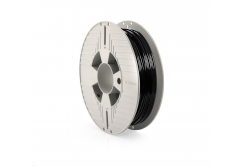
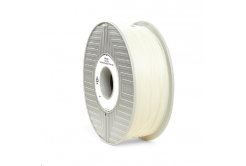
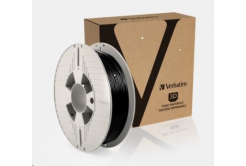


Engineering materials for real-world applications
Verbatim industrial filaments are available in several material types that cover a wide range of modern production requirements:
-
ABS Industrial – a strong and heat-resistant material suitable for structural and mechanical parts.
-
PETG Industrial – a tough, durable and chemically stable filament with smooth flow and excellent layer adhesion.
-
PA6 Nylon – a material with high strength, flexibility and abrasion resistance.
-
PC (Polycarbonate) – extremely strong and heat-resistant for technical parts and covers.
-
TPU Flexible – an elastic and wear-resistant filament for flexible parts and damping components.
Each of these filaments is produced from pure industrial-grade granulates under strict quality control, ensuring stable results even during long print jobs.
Consistent quality thanks to precise manufacturing
Verbatim industrial filaments are manufactured in accordance with the strict standards of the Mitsubishi Chemical Group, which means minimal diameter deviation (±0.02 mm), consistent material density and even pigment distribution.
This allows you to print dimensionally accurate models with excellent layer adhesion and without unwanted warping.
Key advantages of Verbatim industrial filaments:
-
High thermal and mechanical resistance
-
Dimensional accuracy and print stability
-
Excellent layer adhesion and low internal stress
-
Resistance to chemicals, UV radiation and moisture
-
Manufactured from premium Mitsubishi Chemical polymers
-
Odour-free, impurity-free and with excellent flow
Designed for functional and structural parts
Verbatim industrial filaments are commonly used for functional prototypes, technical models, machine parts, brackets, spare parts and equipment housings.
Thanks to their mechanical strength, durability and dimensional stability, they can replace traditionally manufactured plastic components even in real-world operation.
Typical applications:
-
Mechanical engineering and production jigs
-
Automotive and electrical industries
-
Laboratory and test equipment
-
Development of functional prototypes and small-batch production
Print reliability and high performance
Verbatim filaments are designed for high-performance 3D printers with heated beds (up to 120 °C) and nozzles up to 300 °C. An enclosed build chamber is recommended to maintain thermal balance and drying the material before printing helps to achieve maximum print quality.
Recommended printing conditions:
-
Nozzle temperature: 240–300 °C (depending on material)
-
Bed temperature: 80–120 °C
-
Enclosed chamber: recommended for ABS filaments, PA and PC filaments
-
Print speed: 40–60 mm/s
Durability that stands up to industrial use
Unlike standard hobby filaments, Verbatim industrial materials are designed to withstand long-term mechanical stress, chemical exposure and temperature changes. This makes them suitable even for outdoor environments and demanding technical applications.
Why choose Verbatim industrial filaments
-
Quality backed by Mitsubishi Chemical Group
-
Precision and stability for professional printing
-
Resistance to chemicals, UV radiation and temperature fluctuations
-
Compatibility with most industrial 3D printers
-
Materials suitable for demanding structural parts and final products
Materials that go beyond standard 3D printing
If you need to print strong, functional and dimensionally accurate components that must operate reliably even in demanding environments, then Verbatim industrial filaments are the ideal choice.
They combine the technological quality of a Japanese manufacturer, stable performance and long service life of printed parts, making them one of the most reliable industrial filaments on the market.
The Verbatim Industrial Filaments category offers a broad portfolio of engineering materials that move 3D printing from prototyping into true production – with a focus on precision, durability and professional results.