









- One sided adhesive tapes
- Packing tapes
- Coloured - marking tapes
- Electrical tapes
- Office tapes, adhesive tapes
- Slick surface tapes
- Metal adhesive tapes
- Masking crepe tape
- Masking special tapes
- Surface protection tapes
- Foam - sealing tapes
- Anti-slip tapes
- Self-adhesive rubber cut-outs
- Special tapes
- Textile tapes
- Warning and reflective tapes
- Double-sided adhesive tapes
- Electrical insulation material
- Glues
- Flexible stoppers, bumpers
- Velcro straps
- Primers - activators - cleaners
- Accessories for adhesives, applicators
Dot matrix printer – what is its principle?
Dot matrix printers have been on the market for more than 40 years, and so far nothing indicates that these printers are about to give way to modern inkjet or laser devices. Quite the opposite. Many leaders manufacturing office equipment continue to develop dot matrix printers, which is why these devices remain in demand.
For some, this information may sound surprising or even unbelievable, but dot matrix printing technology truly still has something to offer even to today’s well-equipped offices. If you may be wondering right now why dot matrix printing is still used despite the aforementioned more progressive printing methods, know that there are more reasons than you think.

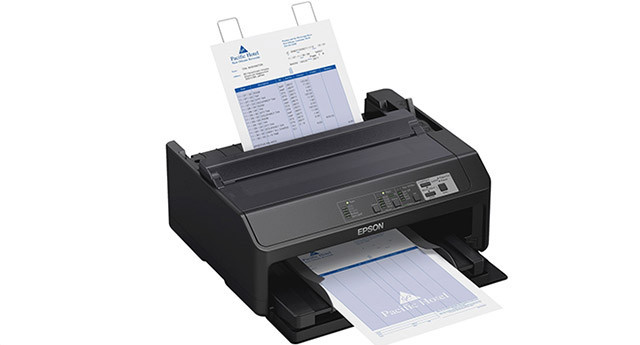
Dot Matrix Printer: Advantages and Disadvantages
Although dot matrix printers do not offer print quality as perfect as inkjet or laser printers and are not suitable for printing more complex graphics, they make up for it with low operating costs, which you can reduce even further with compatible ink ribbons.
Dot matrix printers also impress with printing multiple copies. Unlike other devices, dot matrix printers allow you to print through several layers of paper at once and soon hold up to 9 copies in your hand.Modern dot matrix printers are renowned for their high precision and printing speed, and their strong advantage is minimal failure rate (MTFB 10,000–25,000 operating hours), which goes hand in hand with a long service life. Their compact dimensions are also worth noting.
However, nothing is black and white, and dot matrix printers also have their weaker sides. Apart from lower print quality, their weakness still remains somewhat higher noise, which every printer owner has to deal with in some way. However, the benefits of dot matrix printers certainly outweigh this minor drawback. In the following lines, we will look at the principle of operation of dot matrix printing technology and some of its other parameters.
Principle of the dot matrix printer
Dot matrix printers operate on a similar principle to what we know from typewriters. However, the printer is equipped with 9 or up to 24 pins arranged in a matrix. After a print job is entered, the pins begin striking through the ink ribbon onto the paper, creating text or simple graphics.
Print quality is determined by the number of pins. The basic rule also applies in this case: the more pins a printer has, the higher the print quality and speed. A printer with a higher number of pins in the matrix is usually quieter as well.
From this perspective, the 24-pin printer models are particularly interesting. They are suitable for printing small labels, barcodes, and company documents or contracts with higher print quality requirements. In contrast, 9-pin printers are more suitable for printing accounting documents, where text quality or simple graphics are of lower priority.
Print speed is a pleasant surprise, and the integrated card is a welcome feature
Whereas in the past, owners of older types of printers with one or two pins could brew and leisurely drink a coffee or even step out for lunch while printing multi-page documents, today you will wait incomparably less time for printouts.
For comparison. Current dot matrix printers commonly print 360, 430, or even 680 characters per second, which in practice means that the device can produce one standard A4 page with 1,800 characters in under three seconds. So it is a difference that needs no comment.For the sake of completeness, we should perhaps add that dot matrix printers can be connected directly to the corporate network via an integrated network card and print from any computer, or alternatively a USB port can be used to connect them to a computer. Connecting via an LPT port, if necessary, will not be a problem either.
Tip: Do you know what the difference is between a laser and an LED printer?