









- Automotive
- Sanding - Polishing
- One sided adhesive tapes
- Packing tapes
- Coloured - marking tapes
- Electrical tapes
- Office tapes, adhesive tapes
- Slick surface tapes
- Metal adhesive tapes
- Masking crepe tape
- Masking special tapes
- Surface protection tapes
- Foam - sealing tapes
- Anti-slip tapes
- Self-adhesive rubber cut-outs
- Special tapes
- Textile tapes
- Warning and reflective tapes
- Double-sided adhesive tapes
- Electrical insulation material
- Glues
- Materiály pro výrobu technických štítků
- Flexible stoppers, bumpers
- Velcro straps
- Primers - activators - cleaners
- Accessories for adhesives, applicators
 Monitors
 Laptops
 Desktop computers
- Accessories
- Backpacks and laptop bags
- Electronic gadgets
- Ergonomic accessories
- External drives
- Gamepads
- Gaming tables
- Gaming chairs
- Microphones
- Internal drives
- Cables
- Office chairs
- Keyboards
- Mice
- Power supplies
- Memory cards
- Mouse pads
- Markers
- Projectors and accessories
- Mobile phone accessories
- Speakers
- Keyboard and mouse sets
- Headphones
- USB Flash discs
- Gaming steering wheels
- Scales
- Webcams
Print high-quality textile labels that will represent you appropriately
Textile labels serve several functions. They bear the manufacturer's name, indicate the product's origin, size, material composition, or care instructions. To ensure they remain unchanged even in more demanding conditions, they are made from top-quality materials and using special printing.
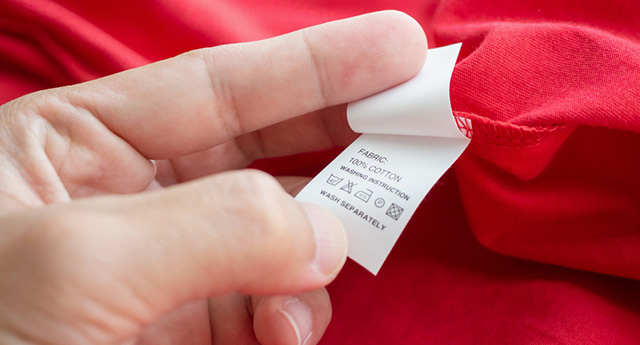
Textile labels have a wide range of uses
If you operate in the textile industry, then you are well aware of the applications of textile labels. They are used for labeling clothing and other products with a textile composition, while allowing the printing of all necessary information about the product and the manufacturer (e.g.: company logo, material composition, size, washing symbols, ironing, barcode and QR code). They are made from high-quality and non-washable materials.
Textile manufacturers sew them either into the neckline or into the side seam of the product. Among the characteristic properties of textile labels printed with TTF ribbons or ribbons intended for hot stamping are high resistance during standard, chemical, and stone washing. This is guaranteed precisely by special printing in thermal printers that use thermal embossing.
What materials are used to make textile labels
Textile labels are produced by special printing on textile ribbons, which are made of satin or nylon. There are certain differences between these two types of fabrics:
- Satin ribbon - this material is softer, has a glossy surface, and is suitable for use in garments that are in direct contact with the skin.
- Nylon - is harder than satin, characterized by a matte surface, and is used for the outer parts of clothing, backpacks, cases, etc.
What the production of textile labels looks like
For printing textile tags and labels with thermal transfer (TTR) printers, foils with a layer of heat-sensitive material (TTR foil) are used, which is transferred onto the printed medium by pressure after being melted by the printer's thermal head. TTR film is also known as TTR ribbon, carbon ribbon, thermal transfer film, or ink ribbon, and serves as a printing medium for thermal transfer printers.
Thermal transfer printing technology for textiles uses the transfer of color from a carrier (ribbon or foil) to the given textile using heat. The thermal transfer head locally melts the ink, which is transferred under pressure onto the textile or medium (thermal transfer). A thin vinyl or plastic film serves as the color carrier, with a width corresponding to the width of the textile ribbon onto which it is printed. The foil itself is wound onto a roll. By local heating, the color from the foil is transferred onto the paper, and the used foil with the minute color is wound onto a second roll. These printers are characterized by low resolution and are often equipped with a cutting plotter that immediately trims the printed labels. They also offer the option to use non-standard colors that ordinary printers cannot handle.
Types of thermal transfer foils
According to the base material, they can be divided into three groups:
- Wax - this type is intended for general use. It is characterized by easy application, high speed, and a low printhead temperature. Used for printing text, barcodes, and paper labels.
- Wax-Resin (wax-resin) - this combination combines the advantages of both types of thermal transfer ribbons - the ribbon is of high quality and resistant to mechanical abrasion. Suitable for overprinting on everything from rough uncoated paper to smooth synthetic surfaces. It is commonly used for printing barcodes, text, and graphics.
- Wax-Resin/wax-resin - Near Edge - ribbons are intended for printers with an angled printhead. Their advantages include good resistance to mechanical abrasion and convincing print quality even at high speeds.
- Resin (resin) - thanks to the resin-based foundation, these ribbons are resistant even to the strongest mechanical and chemical influences. They are ideal for synthetic materials (PP, PE, PET, etc.).
They are characterized by high print quality and maximum resistance to mechanical abrasion, temperatures up to 300 °C (on PA material), steam, or various chemical substances, such as למשל. motor fuels and oils, antifreeze mixtures, products containing ammonia, and the like. We recommend it primarily for printing barcodes, textile ribbons, text, and graphics.
Classification of TTR ribbons by winding
Depending on the type of roll label printers, we distinguish different designs and winding of thermal transfer ribbons:
- "IN" winding - represents a type of winding in which the pigment is located on the inner side of the film
- "OUT" winding - indicates a winding method where the pigment is placed on the outer side of the film