









- Automotive
- Sanding - Polishing
- One sided adhesive tapes
- Packing tapes
- Coloured - marking tapes
- Electrical tapes
- Office tapes, adhesive tapes
- Slick surface tapes
- Metal adhesive tapes
- Masking crepe tape
- Masking special tapes
- Surface protection tapes
- Foam - sealing tapes
- Anti-slip tapes
- Self-adhesive rubber cut-outs
- Special tapes
- Textile tapes
- Warning and reflective tapes
- Double-sided adhesive tapes
- Electrical insulation material
- Glues
- Materiály pro výrobu technických štítků
- Flexible stoppers, bumpers
- Velcro straps
- Primers - activators - cleaners
- Accessories for adhesives, applicators
 Monitors
 Laptops
 Desktop computers
- Accessories
- Backpacks and laptop bags
- Electronic gadgets
- Ergonomic accessories
- External drives
- Gamepads
- Gaming tables
- Gaming chairs
- Microphones
- Internal drives
- Cables
- Office chairs
- Keyboards
- Mice
- Power supplies
- Memory cards
- Mouse pads
- Markers
- Projectors and accessories
- Mobile phone accessories
- Speakers
- Keyboard and mouse sets
- Headphones
- USB Flash discs
- Gaming steering wheels
- Scales
- Webcams
Innovations that are now taken for granted
The printing industry is evolving exceptionally quickly. It is therefore no wonder that it continually offers innovations that, in various ways, make not only printing easier and faster, but also everything related to it. It also emphasizes sustainability and thus contributes to environmental protection. Discover the latest in printing and see for yourself that it will always have something to offer you.
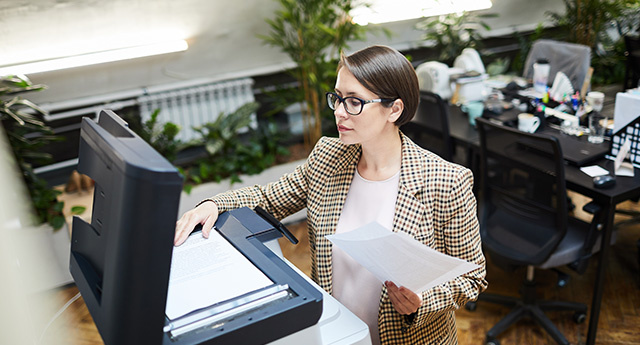
An eco-friendly printer is no longer just a thing of the future
Just as consumers pay attention to the impact they have on the environment, the printing industry is also beginning to place much greater emphasis on sustainability and environmentally friendly production. End users themselves are also increasingly demanding inks that are safer not only for the people who handle them, but also for the entire planet.
Eco-friendly printing itself involves applying eco principles in the three main elements of the printing process - printing technology, inks, and printing materials - in order to reduce their impact on the environment. The aim is to minimize pollution, waste generation, and energy consumption during production. At the same time, it is also about reducing printing costs and protecting the planet. Some companies have also started offering more environmentally friendly water-based inks. These inks contain components that are safer and also more environmentally friendly than liquid toners, UV-curable inks, or solvent-based inks.
Expansion of printing possibilities onto various surfaces
The boom also brought an expansion of industrial printing onto various substrates and shapes. The possibilities for using a printer in this case are truly endless, and the long list even includes materials such as glass, metal, packaging, labels, textiles, or even food. Their number is constantly growing and is now limited only by imagination.
Greater emphasis on print security
Reliable security for printing processes is highly desirable, but currently also relatively demanding. Constantly evolving technologies result in increasingly frequent cyberattacks to which the printer is exposed. Although the introduction of GDPR brought certain improvements in the area of overall security, awareness of diverse security risks is still insufficient.
This is precisely what the continuous innovations in security features are for, which the printer increasingly often has integrated directly from the manufacturer. In addition to basic options such as password or PIN identification, we also include more advanced alternatives here, such as the use of an identification card or biometrics.
Printer now with artificial intelligence too
The use of artificial intelligence to facilitate individual work tasks has also extended into the field of printing. As early as 2018, several basic voice recognition capabilities were introduced in some smart printers and multifunction devices from Xerox and HP.
The printer typically uses artificial intelligence to automate tasks that present certain disadvantages in the printing process regarding speed, efficiency, or print quality. This means that it facilitates the overall process of digitizing, editing, archiving, or reprinting documents and at the same time reduces error rates. Even in network configurations, artificial intelligence determines which printers are overloaded and redirects new print jobs to less utilized printers.
Multifunctionality in the area of printing processes
Support for platforms for storing and distributing documents to various systems is gaining importance. Most companies realize that the digitization of paper-based processes is playing an increasingly important role for business. That is why further expansion of services in the form of multifunction printers is appropriate, because the current ones can no longer cover their needs.
The development of smartphones, tablets, and televisions with a multitude of applications has also significantly influenced the printing industry. The smart printer allows you to work with digital documents without even having to turn on your computer, which ultimately saves both time and money. Many printers even come with certain applications or app stores preinstalled, which simplify the entire printing process.