









- Automotive
- Sanding - Polishing
- One sided adhesive tapes
- Packing tapes
- Coloured - marking tapes
- Electrical tapes
- Office tapes, adhesive tapes
- Slick surface tapes
- Metal adhesive tapes
- Masking crepe tape
- Masking special tapes
- Surface protection tapes
- Foam - sealing tapes
- Anti-slip tapes
- Self-adhesive rubber cut-outs
- Special tapes
- Textile tapes
- Warning and reflective tapes
- Double-sided adhesive tapes
- Electrical insulation material
- Glues
- Materials for the production of technical labels
- Flexible stoppers, bumpers
- Velcro straps
- Primers - activators - cleaners
- Accessories for adhesives, applicators
 Monitors
 Laptops
 Desktop and gaming computers
- Accessories and Add-ons
- Backpacks and laptop bags
- Electronic gadgets
- Ergonomic accessories
- External drives
- Gamepads
- Gaming tables
- Gaming chairs
- Microphones
- Internal drives
- Cables
- Office chairs
- Keyboards
- Mice
- Power supplies
- Memory cards
- Mouse pads
- Projectors and accessories
- Mobile phone accessories
- Speakers
- Keyboard and mouse sets
- Headphones
- USB Flash discs
- Gaming steering wheels
- Scales
- Webcams
How does an inkjet printer work?
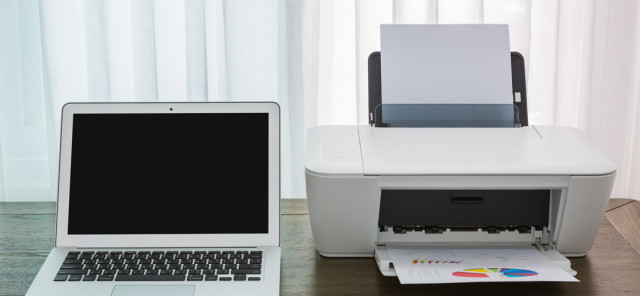
It has long been no longer true that an inkjet printer represents a financially demanding or even slow printing alternative. Current inkjet printers are the best proof of this. Today, thanks to modern technologies, this type of printing can rightfully boast attributes such as speed, reliability, and energy or operational efficiency.
A Brief Look into History
Several decades have passed since inkjet printers were introduced to the market. Over that time, these printers have undergone significant development and have become an indispensable part of the equipment not only of offices, but also of many households.
The successful era of inkjet printers began as early as the first half of the 1980s. Until then, the most commonly used dot matrix printers were dealt a hard blow in the form of the competing HP ThinkJet inkjet printer, which was introduced by Hewlett-Packard.
An inkjet printer with quieter operation, lower consumption, and above all higher print quality, together with expanded graphic capabilities, has revealed a completely new potential for printers.
Only a little later, Epson and Dataproducts introduced their inkjet printer models, so it was only a matter of time before further technological improvements arrived.At the beginning of the 1990s, inkjet printers were already of sufficiently high quality and also represented an attractively priced printing alternative. Development naturally progressed, and today’s inkjet printers can match laser printers in print quality and speed.
How does an inkjet printer work?
In general, the principle of an inkjet printer consists in ejecting microscopic droplets of ink from the print head. Before this happens, the print head must be filled with ink from the cartridges using a special pump.Then colored drops of ink are sprayed onto the paper through nozzles under pressure.
Most inkjet printers use CMYK cartridges for color mixing (Cyan, Magenta, Yellow, and Black).Other color shades are created by combining these basic colors. Within inkjet printing, there are 3 distinct alternatives for applying ink.
TIP: You can buy ink cartridges for printers from us.
1. Thermal printing
In this method of application, ink from the color reservoir is fed into the nozzles, inside which resistors are located. They heat the print to a high temperature, which simultaneously increases the pressure, and the ink is subsequently ejected through nozzles onto the paper. Chemical processes then ensure the fixation of the ink.
The desired colors are mixed directly on the paper by overlapping individual microscopic droplets or by placing droplets side by side so that, under normal viewing conditions, it is not possible to distinguish the separate colors. The final print quality is also influenced, among other things, by the density of placement of individual droplets.
2. Piezoelectric printing
Piezoelectric printing, similarly to thermal printing, uses generated pressure to eject droplets when applying ink. However, the difference is that in this case the pressure is not a result of high temperature, but is generated by the action of electric current on a piezoelectric element. It "deforms" and the pressure created shoots the ink onto the paper. The printer's intelligent control unit also optimizes the shape of the ejected droplets to achieve the highest possible print quality.
3. Wax printing
This ink application is essentially a combination of piezoelectric and laser printing. The ink has a wax-like consistency that melts when heated and is mixed to the desired shade in the print head. After mixing the appropriate shade, the ink, just like in piezoelectric printing, is ejected under pressure. This time, however, not directly onto paper, but first onto a drum, similarly to how it works in laser printing. However, unlike laser printing, after the paper is pressed onto the drum, the ink is not fused.
Which inkjet printer is the best?
When choosing a printer, consider your actual needs. Inkjet multifunction printers using thermal printing technology are affordable and suitable not only for home use, but also for smaller businesses that do not require large print volumes. These inkjet printers make it possible to produce high-quality photographs and detailed graphics. Printers operating on the piezoelectric principle or using wax printing are more likely to find application in the business or industrial segment.
TIP: Laser or inkjet, which printer should you get?
What technological innovations the future will bring to printers is difficult to predict today. One thing is certain. Every year, newer and newer technologies emerge, trying to win our favor and capture our attention. We have something to look forward to!