









- Automotive
- Sanding - Polishing
- One sided adhesive tapes
- Packing tapes
- Coloured - marking tapes
- Electrical tapes
- Office tapes, adhesive tapes
- Slick surface tapes
- Metal adhesive tapes
- Masking crepe tape
- Masking special tapes
- Surface protection tapes
- Foam - sealing tapes
- Anti-slip tapes
- Self-adhesive rubber cut-outs
- Special tapes
- Textile tapes
- Warning and reflective tapes
- Double-sided adhesive tapes
- Electrical insulation material
- Glues
- Materiály pro výrobu technických štítků
- Flexible stoppers, bumpers
- Velcro straps
- Primers - activators - cleaners
- Accessories for adhesives, applicators
 Monitors
 Laptops
 Desktop computers
- Accessories
- Backpacks and laptop bags
- Electronic gadgets
- Ergonomic accessories
- External drives
- Gamepads
- Gaming tables
- Gaming chairs
- Microphones
- Internal drives
- Cables
- Office chairs
- Keyboards
- Mice
- Power supplies
- Memory cards
- Mouse pads
- Projectors and accessories
- Mobile phone accessories
- Speakers
- Keyboard and mouse sets
- Headphones
- USB Flash discs
- Gaming steering wheels
- Scales
- Webcams
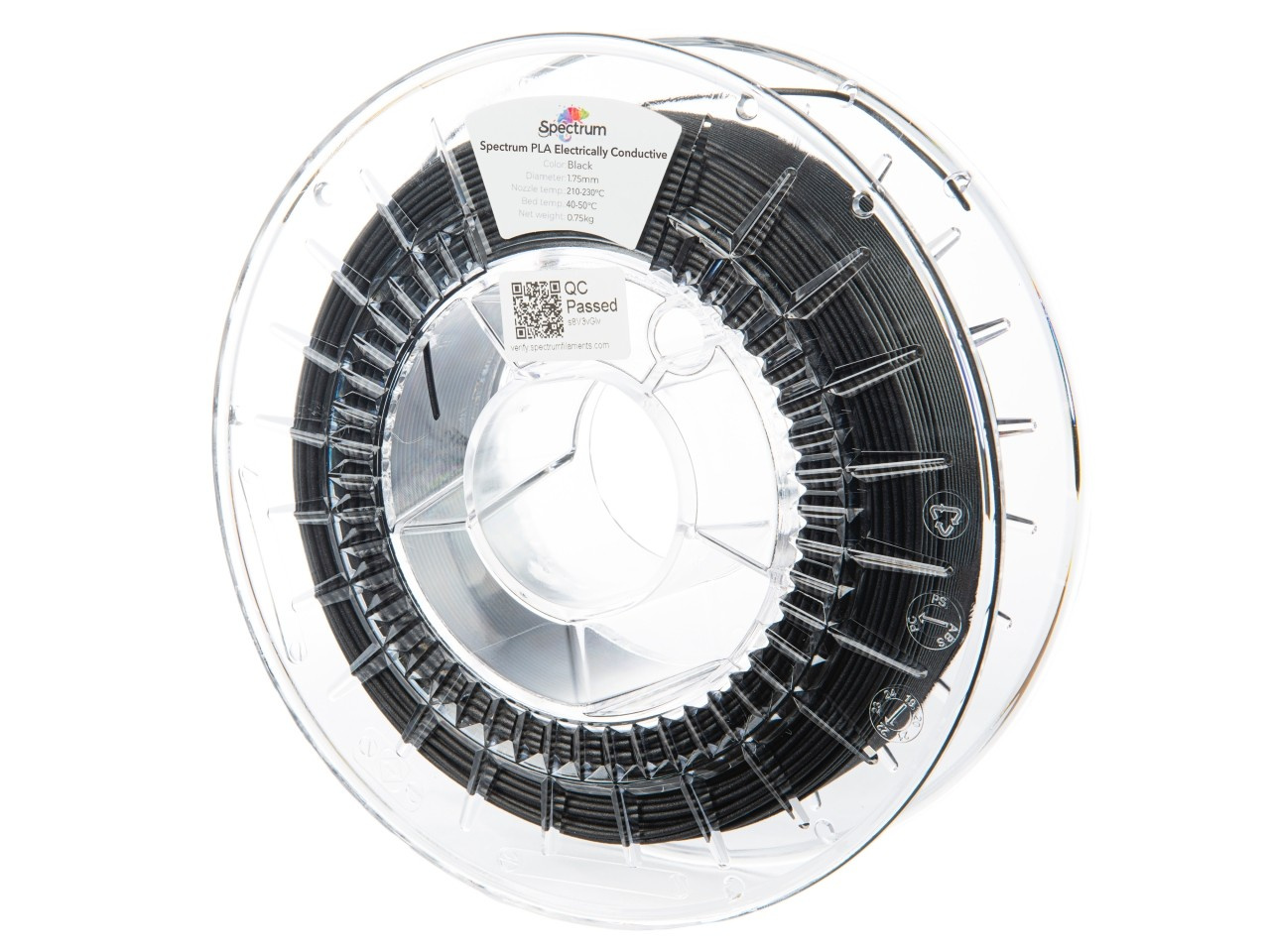
Spectrum 81595 3D filament, PLA Electrically Conductive, 1.75mm, 750g, Black
Parameters
Product description
Spectrum PLA Electrically Conductive is a specialized technical filament designed for applications where electrical conductivity is required in combination with the ease of printing typical for PLA. The base is a PLA polymer enriched with carbon nanotubes (CNT), which significantly reduce surface resistance, making the filament suitable for producing parts that require basic electrical conductivity.
Despite its functional conductivity, the filament retains all the main advantages of regular PLA – easy printability, low shrinkage, and no need for a heated chamber. Thanks to this, Spectrum PLA Electrically Conductive is ideal for prototyping, educational environments, and technical workshops, where the combination of functionality and simple, hassle-free printing is important. The finished prints also have a matte finish, which enhances the aesthetics of the result and helps to hide visible layers.
Due to the carbon nanotube content, the filament is slightly abrasive, so we recommend using a hardened or ruby nozzle.
Interpretation of Volume Resistivity Test
To verify the conductive properties of the filament, measurements were conducted on a 3D printed sample with dimensions of 4 × 4 × 120 mm (100% infill), at a voltage of 10 V and three different extrusion temperatures: 210 °C, 220 °C, and 230 °C.
The measured values of volume resistivity were:210 °C: 120 Ω·m
220 °C: 103 Ω·m
230 °C: 97 Ω·m
The results clearly show that higher extrusion temperature improves electrical conductivity. Higher temperature supports better dispersion of carbon nanotubes in the material, which leads to a reduction in volume resistivity. For users, this means that when printing parts where conductivity is a priority, it is advisable to choose higher extrusion temperatures (up to 230 °C) – of course, within the capabilities of the specific printer.
Material Properties
Very low surface resistivity (~40 Ω·m)
Electrical Conductivity
High stiffness and dimensional stability
Resistance to UV radiation and weather conditions
Matte finish to reduce layer visibility
How to use
Nozzle temperature [°C]: 210–230 °C
Bed temperature [°C]: 40–60 °C
Recommended printing speed [mm/s]: 30–120 mm/s
Cooling: up to 100%
Closed chamber: not required
Dry storage (Drybox): not required
Recommended nozzle: hardened steel or ruby (the material is slightly abrasive)
Adhesion: not necessary, optional: Dimafix / 3DLac / Magigoo for higher certainty and reduced warping

