









- One sided adhesive tapes
- Packing tapes
- Coloured - marking tapes
- Electrical tapes
- Office tapes, adhesive tapes
- Slick surface tapes
- Metal adhesive tapes
- Masking crepe tape
- Masking special tapes
- Surface protection tapes
- Foam - sealing tapes
- Anti-slip tapes
- Self-adhesive rubber cut-outs
- Special tapes
- Textile tapes
- Warning and reflective tapes
- Double-sided adhesive tapes
- Electrical insulation material
- Glues
- Flexible stoppers, bumpers
- Velcro straps
- Primers - activators - cleaners
- Accessories for adhesives, applicators
Discover the options for marking electrical conductors and choose the most suitable alternative
The marking of insulated electrical conductors is governed by several technical standards. Marking conductors with colors or numbers serves both to increase the safety of people and property and, on the other hand, to help simplify installation work, inspections, maintenance, and repairs. Since various alternatives are possible when marking wires and cables, we will look at their strengths and weaknesses.
Heat-shrink tubing marking as a sign of economy. After each page
The combination of modern printers with thermal transfer printing technology, compatible ink ribbons, and round, star-shaped, or oval marking sleeves delivers highly reliable results in the marking of cables and wires. It is therefore no surprise that we started with this fast and economical alternative. Not only from an economic perspective. Sleeve marking not only brings interesting financial savings, but unlike marking with sleeves, for example, it does not take up much space and is therefore ideal for marking a larger number of cables in devices with tighter space.
As we have already indicated, marker sleeves are available in round, star-shaped, or oval designs. The diameter of the sleeves starts at 2 mm and continues in nearly regular 0.5 mm increments up to a diameter of 7 mm. In practice, this means that after printing, you can slide the sleeves onto conductors of varying thicknesses.Additionally, the star-shaped and oval sleeves will not slide along the wire - they do not travel. But you don't have to stick only to round, star-shaped, or oval sleeves.
When you require flawless insulation of a wire or cable, heat shrink tubing with a shrink ratio of 2:1 or 3:1 will also serve you perfectly. The disadvantage of marking with sleeves is the need to disconnect the connected wires and slide the sleeve on.
Among the favorites is sleeve marking
Compared to other methods of marking cables and wires, sleeve marking is a more expensive but also more versatile alternative.
Translucent or colored plastic sleeves of various lengths thus allow for more comfortable sliding onto or snapping onto cables and wires of different diameters. Simply put, one type of plastic sleeve with a flat or rounded pocket, into which labels or strips with printed information are inserted, can, thanks to its profile, be used for marking cables with a diameter of 8 mm, or even 16 mm.However, the aforementioned benefit is not their only advantage. It is also necessary to mention the fact that marking with sleeves allows quick and uncomplicated marking of already connected cables or wires. The disadvantages of this marking include the space requirements of the packages. This marking of conductors and cables is therefore more difficult to implement in electrical equipment with limited space capacity. However, do not be misled. Sleeve marking can also be used for professional cable marking when lower requirements for the volume of descriptions are needed.
Labeling with tags can be a good choice, as can labeling with sleeves
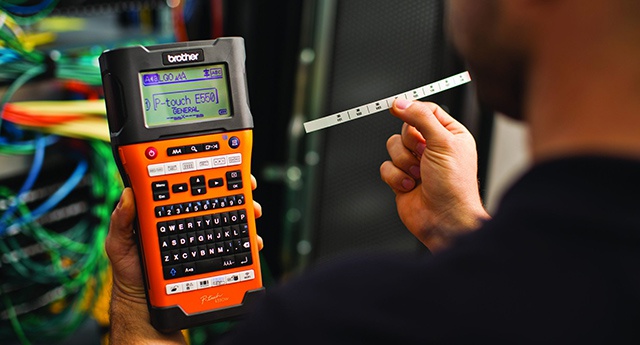
Labeling with tags attracts attention primarily due to its versatility and low acquisition costs for tags and tapes for label makers. You will not be any worse off, however, even when purchasing label markers on their own. Both of the aforementioned benefits thus, to a certain extent, compensate for the greater labor intensity involved in marking wires and cables. The labels themselves have no problem with any wire or cable thickness, but wrapping them around the wire is a bit of a different matter. However, these concerns are not entirely justified. With a little skill, the labels will be in place fairly quickly, and it will be up to you whether you simply wrap the labels around the wires or create little flags. Labeling labels is ideal for occasional cable labeling.
The options for marking wires and cables naturally do not end with labels. There is also the sleeve marking available. Sleeve marking, unlike any of the alternatives mentioned so far, does not require any marker, because it uses sleeves with pre-made codes, symbols, letters, or numbers. Sleeve marking, similarly to label marking, is particularly suitable for occasional conductor marking.