









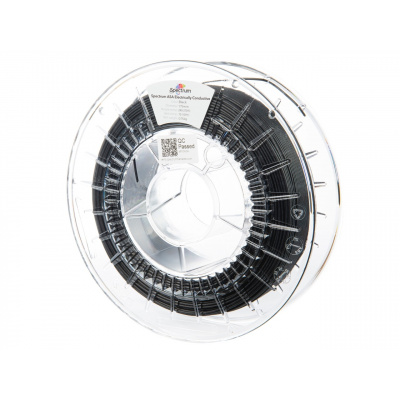
Product description Spectrum 81592 3D filament, ASA Electrically Conductive, 1,75mm, 750g, Black
| Color | Black |
| Packaging | 750 grams |
| Type of material | ASA Electrically Conductive |
| String diameter | 1,75 mm |
| Printing temperature | 240 - 270°C |
| Type of filament | With reel (full version) |
Spectrum ASA Electrically Conductive is an advanced technical filament developed for professional use where electrical conductivity and high resistance to external factors are essential. The base material consists of durable ASA polymer enriched with carbon nanotubes (CNT), which provide it with very low surface resistivity – approximately 40 Ω. This makes this filament an ideal choice for applications requiring efficient electrical conductivity.
In addition to its conductive properties, Spectrum filament ASA Electrically Conductive also offers excellent resistance to UV radiation and weather conditions, making it a perfect material for outdoor use.
The filament is characterized by high rigidity, good dimensional stability, and mechanical strength, making it suitable for the production of technical components that must reliably function even in demanding environments. The prints have a matte finish, which not only looks aesthetically pleasing but also conceals layers and minimizes the need for further processing.Although this material does not require a heated chamber, its use can improve stability when printing larger parts.
Due to the carbon nanotube content, the filament is slightly abrasive, so we recommend using a hardened steel or ruby nozzle. Spectrum filament ASA Electrically Conductive is an excellent choice for users looking for a durable, weather-resistant, and electrically conductive material for specialized technical prints.Measurement of Volume Resistivity
To verify the conductive properties, tests were conducted on a 3D-printed sample with dimensions of 4 × 4 × 120 mm (100% infill), at a voltage of 10 V and three different extrusion temperatures: 270 °C, 280 °C, and 290 °C.
The determined values of volume resistivity were as follows:- 270 °C: 51 Ω·m
- 280 °C: 45 Ω·m
- 290 °C: 41 Ω·m
The results confirm that increasing the extrusion temperature improves the conductivity of the filament. Higher temperature aids in better dispersion of carbon nanotubes within the model's structure, leading to lower bulk resistivity. For users, this means that the highest conductivity is achieved at higher extrusion temperatures (up to 290 °C), if the printer's design allows it.
Material Properties
- Very low surface resistivity (~40 Ω·m)
- Electrical conductivity
- High rigidity and dimensional stability
- Resistance to UV radiation and weather conditions
- Matte surface to reduce layer visibility
Recommended Use / Print Settings
Nozzle Temperature [°C]
240–270 °C
Bed temperature [°C]
80–100 °C
Recommended printing speed [mm/s]
30–120 mm/s
Cooling
0–50%
Enclosure (closed chamber)
recommended for larger prints
Drybox
not necessary
Ruby or hardened nozzle
yes, recommended
Adhesive
is not necessary (to increase adhesion or reduce warping, you can use: Dimafix, 3DLac, Magigoo)