









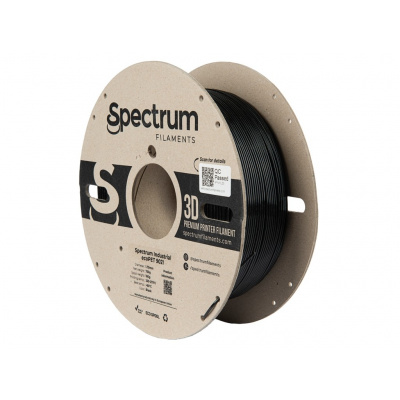
Product description Spectrum 80715 3D filament, ecoPET 9021, 1,75mm, 750g, Black
| Color | černý |
| Packaging | 750 grams |
| Type of material | ecoPET 9021 |
| String diameter | 1,75 mm |
| Printing temperature | 240 - 270°C |
| Type of filament | With reel (full version) |
Ecological, technical material
Spectrum ecoPET 9021 is another of the polyester technical materials in our offer. Unlike the more commonly used PET-G in 3D printing, it is based on a variant of polyethylene terephthalate (PET) that is not modified with glycol. The absence of glycol results in significantly higher stiffness and tensile strength of PET compared to PET-G.
In line with the movement to maximize the share of recycled materials in production, we decided to use recycled material as a raw material source when launching the ecoPET 9021 technical fiber. In the case of traditional recycling, which involves the regranulation of flakes from shredded bottles, it is very difficult to achieve the appropriate purity and homogeneity of the material. This is mainly due to the fact that the packaging is produced by different manufacturers from different types of PET. A mixture of different materials usually results in subsequent problems when printing filament made from such regranulate.
To ensure quality and easy printing, the felt made from recycled material must be characterized by high purity and homogeneity, which is why we opted for a more modern raw material created by chemical depolymerization and repolymerization of waste.
Thanks to this, the Spectrum ecoPET 9021 felt does not differ in terms of printability from other materials derived from primary plastics, while maintaining more than 90% recycled content in its composition.The result of this approach is a reproducible, ecological, and printable filament, whose advantage over classic PETG is not only an impressive temperature resistance of up to 125 °C (max. 200 h) and low water absorption, but also higher tensile strength and stiffness. Filament Spectrum ecoPET 9021 can be used for prints requiring high stiffness and chemical and thermal resistance. Areas of application include functional prototypes and serial parts in a wide range of industries, such as engineering, automotive, and healthcare.
Material Properties
- thermal resistance up to 125 °C (max. 200 h)
- tensile strength increased by 20% compared to regular PET-G
- stiffness increased by 50% compared to regular PET-G.
- good chemical resistance
- high surface quality after printing
- good impact strength
- perfect layer bonding
Applications
- functional prototypes
- manufacturing tools
- zero-waste part production.
- manufacturing of parts exposed to chemical substances